
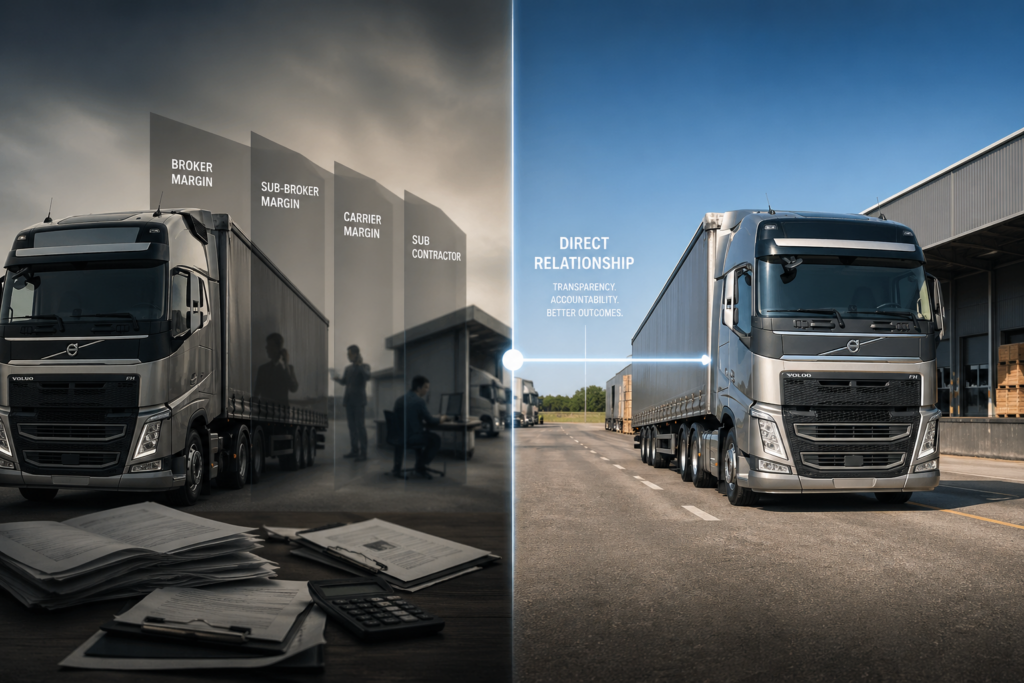
In South Africa’s road transport industry, brokers have become a familiar part of how loads are moved.
On the surface, the model appears efficient:
You have freight. A broker finds a truck. The job gets done.
Simple.
But beneath that simplicity lies a structure that often increases your total cost, reduces visibility, and creates misalignment between your business and the people moving your product.
And over time, those hidden inefficiencies compound.
The Hidden Margins You Don’t See
Broker-based models are built on margin.
That margin is not always visible—and that’s where the first problem starts.
In many cases:
- You are paying a rate that includes a broker’s markup
- The transporter is receiving a lower rate than what you are paying
- Neither side has full visibility of the actual spread
This creates a disconnect.
From your perspective, transport appears expensive.
From the transporter’s perspective, the rate often feels unsustainable.
That gap doesn’t disappear—it shows up elsewhere:
- In service inconsistency
- In equipment quality
- In long-term reliability
You may believe you are paying for a premium service, while the transporter is operating under pressure to make the numbers work.
That is not a stable foundation.
The Transparency Problem
In any supply chain, visibility drives control.
Broker models limit that visibility.
You often don’t know:
- Who the actual transporter is until late in the process
- Whether the same operator will handle your loads consistently
- What standards, systems, or compliance frameworks are in place
This lack of transparency introduces risk.
Because when something goes wrong:
- Accountability becomes blurred
- Communication slows down
- Resolution takes longer
And in industries like agriculture, FMCG, mining, and manufacturing—where timing is critical—delays don’t just inconvenience operations.
They cost money.
Misaligned Incentives Create Long-Term Risk
Perhaps the most overlooked issue in broker-based models is incentive alignment.
A broker typically earns by:
- Securing a load
- Placing a truck
- Moving on to the next transaction
Their focus is volume and turnover.
Your focus, however, is very different:
- Consistency
- Reliability
- Cost control
- Long-term performance
These objectives don’t always align.
As a result:
- Short-term decisions are prioritised over long-term outcomes
- Transporters are selected based on availability, not suitability
- Relationships remain transactional, not strategic
Over time, this leads to variability in service quality—and ultimately, increased operational cost.
The Compounding Effect on Your Business
Individually, these issues may seem manageable.
But together, they create a compounding effect:
- Higher effective transport costs
- Increased operational friction
- Greater exposure to service risk
- Reduced ability to plan and scale
And most importantly:
You lose control over a critical part of your supply chain.
A Better Approach: Direct, Structured Transport Models
There is a more effective way to manage transport—one that leading businesses are quietly shifting toward.
A direct, structured model.
This approach is built on:
- Direct relationships with vetted transporters
- Clear rate structures with no hidden layers
- Defined performance standards and accountability
- Ongoing coordination and oversight
Instead of reacting to availability, you build a reliable transport ecosystem around your business.
The result:
- Greater cost clarity
- Improved service consistency
- Stronger alignment between all parties
- Reduced operational risk
Moving From Transactions to Control
The difference between the two models is simple:
Broker-based model:
You are buying transport as a transaction.
Direct, structured model:
You are building transport as a capability.
That shift changes everything.
It moves you from:
- Uncertainty to predictability
- Reactive decisions to planned execution
- Hidden costs to controlled spend
Final Thought
Transport is not just a line item in your business.
It is a critical lever that directly impacts your margins, your service delivery, and your reputation in the market.
The model you choose matters.
Because while broker-based transport may appear convenient in the short term, the long-term cost—financially and operationally—is often far higher than it seems.
A Practical Question to Consider
If you had full visibility, aligned incentives, and structured control over your transport network…
How much more efficient could your operation become?