
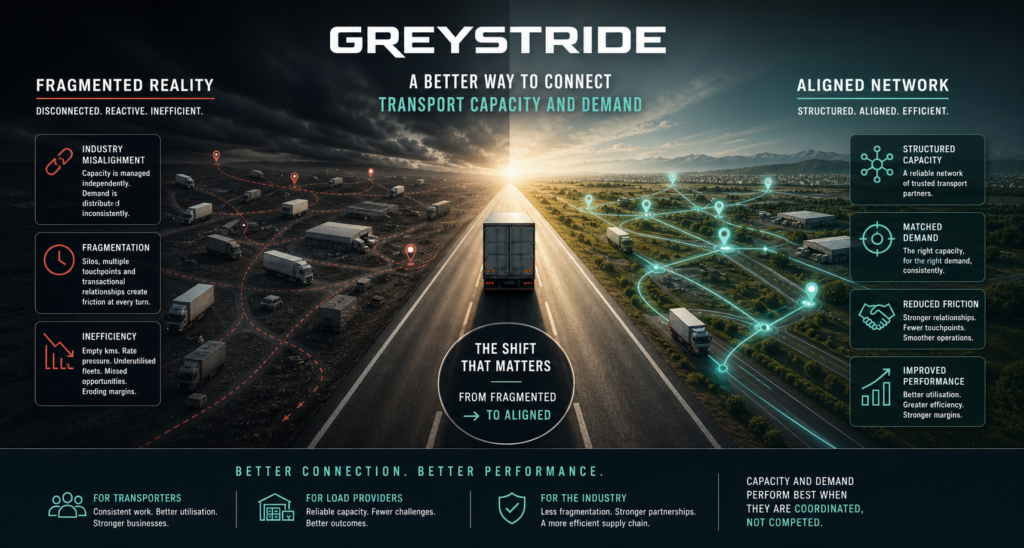
South Africa’s transport industry doesn’t have a capacity problem.
It has a coordination problem.
Every day, thousands of trucks move across the country—moving FMCG, agricultural produce, mining commodities, and manufactured goods. Yet, despite this activity, inefficiencies remain deeply embedded in how capacity and demand connect.
Loads go uncovered. Trucks run empty. Margins are squeezed. Relationships become transactional.
And over time, this misalignment quietly erodes profitability across the entire value chain.
The Reality: A Fragmented System
At its core, the industry operates in silos.
- Load providers rely on multiple transporters, often without visibility or alignment
- Transporters depend on brokers or inconsistent work pipelines
- Brokers sit in the middle, focused on transactions rather than long-term optimisation
Each part of the system is trying to solve its own problem.
But no one is solving the system itself.
The result?
A fragmented network where:
- Capacity exists, but isn’t optimally utilised
- Demand exists, but isn’t consistently fulfilled
- Decisions are reactive instead of strategic
This isn’t a supply issue. It’s a structure issue.
Where the Inefficiency Really Lies
The hidden cost in this model isn’t always obvious—but it’s significant.
It shows up as:
- Empty return legs that were never coordinated
- Rate pressure caused by inconsistent work allocation
- Underutilised fleets despite “being busy”
- Missed opportunities due to lack of alignment
In many cases, transporters are working harder than ever… but not getting ahead.
And load providers are moving freight… but not optimally.
The Core Problem: Misalignment
The industry has evolved into a system where:
- Capacity is managed independently
- Demand is distributed inconsistently
- Relationships are short-term and price-driven
There is no central alignment between:
- Who has capacity
- Who needs capacity
- How that capacity should be deployed
Without alignment, efficiency is left to chance.
And chance is expensive.
A Better Way Forward
What if capacity and demand weren’t connected transaction by transaction?
What if they were structured, aligned, and managed as part of a coordinated network?
This is where a shift in thinking becomes necessary.
Not more brokers.
Not more transporters.
Not more negotiation.
But better structure.
Introducing a Managed Approach
At Greystride, we’ve taken a different view of the problem.
Instead of operating within the fragmented system, we focus on aligning it.
Our Managed Network model is built around a simple principle:
Capacity and demand perform best when they are coordinated, not competed.
Rather than treating each load as an isolated transaction, the model focuses on:
- Structuring capacity into a reliable, aligned network
- Matching demand with the right capacity consistently
- Reducing friction between load providers and transporters
- Creating stability instead of volatility
This isn’t about adding another layer to the industry.
It’s about removing the inefficiencies that already exist within it.
What This Means in Practice
For transporters:
- More consistent, predictable work
- Better utilisation of fleets
- Reduced dependency on unstable load pipelines
For load providers:
- Reliable access to aligned capacity
- Fewer coordination challenges
- Improved operational efficiency
For the industry:
- Less fragmentation
- Better utilisation of existing assets
- Stronger, more sustainable relationships
The Shift That Matters
The future of transport in South Africa won’t be defined by who has the most trucks.
It will be defined by who connects capacity and demand most effectively.
The current model relies on constant negotiation, reactive decisions, and fragmented relationships.
A better model is structured, aligned, and intentional.
Final Thought
The industry doesn’t need more movement.
It needs better connection.
And those who understand this shift early will be the ones who move ahead—while others continue to move… without real progress.