
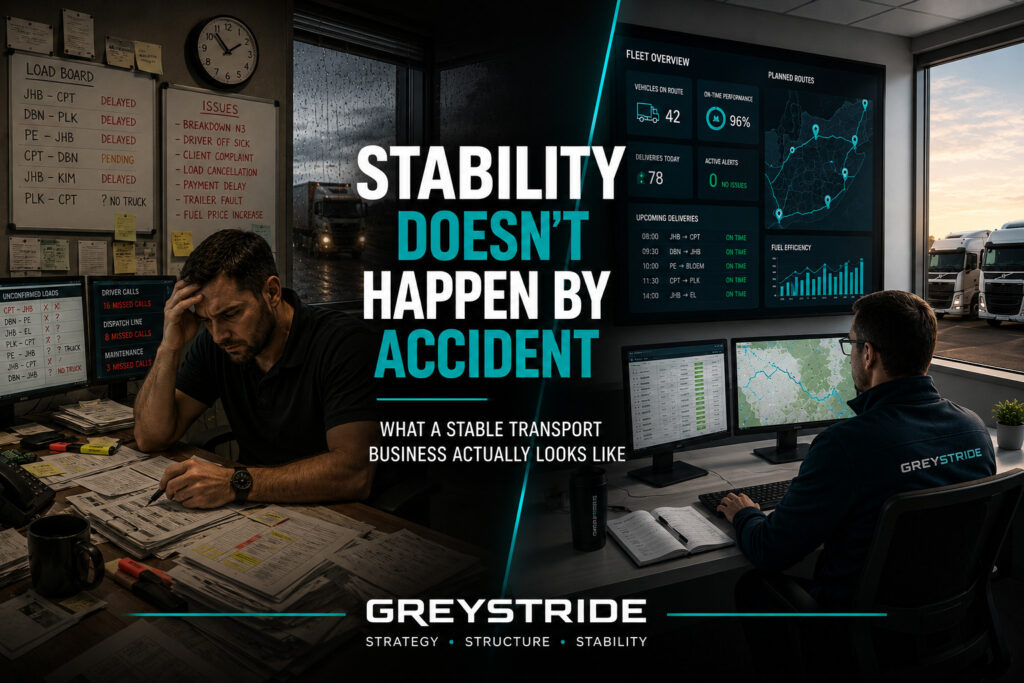
A well-structured business looks different.
From the outside, it may not appear dramatically bigger than the fleets around it. It may not have the newest trucks, the largest depot, or the most employees. In many cases, it looks surprisingly ordinary.
The difference becomes visible when conditions become difficult.
When freight volumes fluctuate, fuel prices increase, a major customer changes procurement requirements, or competitors begin cutting rates, some transport businesses immediately come under pressure. Others continue operating with confidence and control.
That difference is rarely accidental.
In the South African transport industry, stability is often misunderstood. Many operators associate stability with keeping trucks moving and generating turnover. While both are important, they do not automatically create a stable business.
A fleet can be fully utilised and still be vulnerable.
A stable transport business usually shares a number of common characteristics.
Its customer base is not dependent on a single source of work. Revenue is spread across multiple relationships, industries, or freight streams.
Its rates are understood and managed. Decisions are not driven by desperation to secure the next load. The business knows what it costs to operate and understands where profitability comes from.
Its operations are predictable. Vehicles are maintained properly. Drivers understand expectations. Customers receive a consistent level of service.
Its cash flow is under control. Management has visibility of upcoming commitments and is not constantly reacting to financial pressure.
Most importantly, its growth is intentional.
New opportunities are evaluated against long-term objectives rather than short-term urgency.
When you look closely at successful transport businesses, this pattern appears repeatedly.
They spend less time chasing work and more time managing relationships.
They spend less time solving avoidable operational problems and more time improving performance.
They spend less time reacting to market pressure and more time positioning themselves for future opportunities.
The result is not perfection.
Breakdowns still happen. Customers still change requirements. Markets still shift.
The difference is that the business has enough structure to absorb these challenges without creating instability across the entire operation.
This is where many transport operators miss an important point.
Stability is not an outcome that appears after years of growth.
It is often the result of deliberate decisions made much earlier.
The businesses that appear calm and controlled today usually invested time building systems, relationships, operational discipline, and commercial structure long before they needed them.
Structure creates predictability.
Predictability creates confidence.
Confidence creates better decisions.
And over time, those decisions compound into a stronger business.
The encouraging reality is that stability is not reserved for large fleets.
It is not dependent on having one hundred trucks, a national footprint, or a major corporate customer.
Many smaller operators have built remarkably stable businesses because they focused on creating the right foundations rather than simply pursuing more volume.
That is why stability should not be viewed as a future destination.
It should be viewed as something that is intentionally built.
Every process, customer relationship, commercial decision, and operational standard contributes to it.
Over time, those individual decisions create a business that can withstand market changes while continuing to grow.
This is what stability actually looks like.
The real question is whether your current model supports where you want to go.