
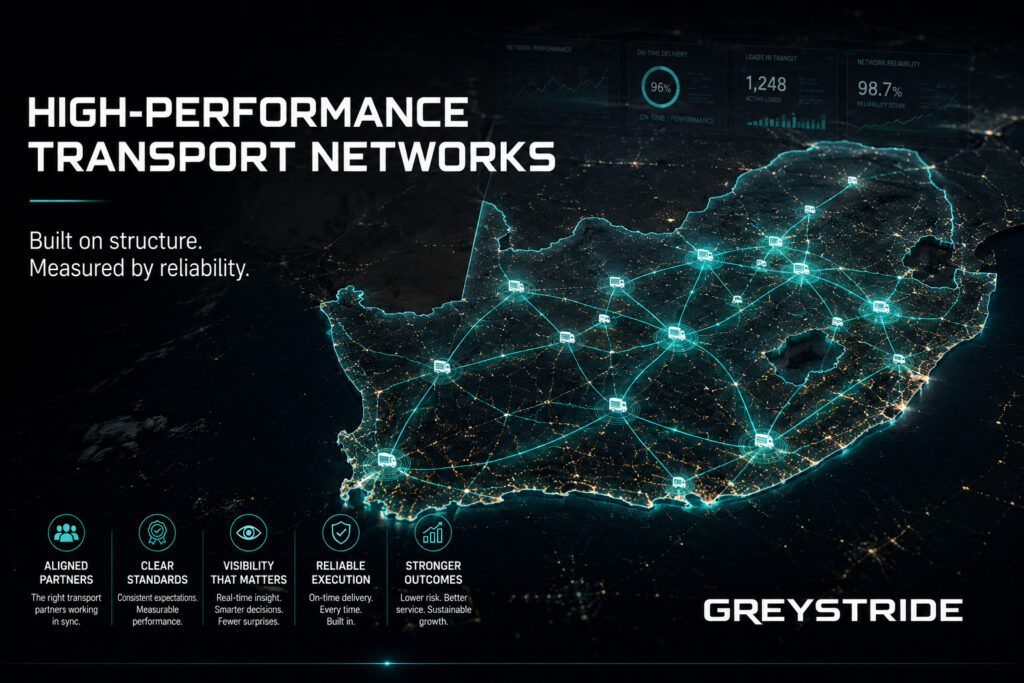
A well-structured transport network looks different.
Not louder. Not bigger. Not necessarily cheaper.
From the outside, it can even appear ordinary. Trucks arrive. Loads move. Deliveries happen.
But beneath the surface, something very different is happening.
The operation is predictable.
The relationships are stable.
The people involved know what is expected of them.
And when pressure inevitably arrives, the network continues to perform.
That is what high performance actually looks like.
The Reality Most Businesses Experience
Many transport networks are built around availability rather than alignment.
A load needs to move, so a transporter is found.
Another load needs to move, so another transporter is found.
Over time, the network becomes a collection of suppliers rather than a coordinated transport operation.
The result is familiar.
Different service levels.
Different communication standards.
Different operating disciplines.
Different levels of accountability.
Most of the time, it works well enough.
Until volumes increase.
Until customer expectations rise.
Until a key supplier becomes unavailable.
Until a disruption exposes weaknesses that have existed for years.
The challenge is rarely the movement of freight itself.
The challenge is the lack of consistency across the network responsible for moving it.
What High Performance Actually Looks Like
High-performance transport networks are built differently.
The transporters operating within the network are known, understood, and trusted.
Performance expectations are clear.
Service standards are consistent.
Communication flows efficiently.
Responsibilities are defined.
Everyone understands the role they play in achieving the outcome.
This creates something many businesses spend years trying to achieve:
Predictability.
Loads move through a system rather than through a series of individual transactions.
The focus shifts from constantly finding capacity to managing performance.
Instead of reacting to transport problems, you spend more time preventing them.
Instead of wondering what will happen next, you have confidence in what is likely to happen next.
That confidence changes the way a transport operation functions.
The Difference Is Not More Transporters
A common assumption is that stronger transport performance comes from having more transport providers available.
In reality, high-performing networks are usually built on stronger relationships with the right transport providers.
The objective is not endless options.
The objective is dependable execution.
The transporters understand your operation.
They understand your products.
They understand your customers.
They understand the consequences of failure.
Because of that understanding, decisions are made faster, communication improves, and issues are resolved before they become major disruptions.
The network becomes stronger because the relationships become stronger.
Structure Creates Outcomes
When businesses look at transport performance, they often focus on outcomes.
On-time delivery.
Customer service.
Availability.
Cost control.
Reliability.
These outcomes matter.
But outcomes are usually the result of something deeper.
They are the result of structure.
A structured transport network creates consistency.
Consistency creates reliability.
Reliability creates confidence.
Confidence creates better planning, stronger customer relationships, and greater operational stability.
The businesses with the most reliable transport operations are rarely relying on luck.
They are benefiting from structures that make reliability more likely.
Why This Matters
Transport is no longer simply about moving goods from one point to another.
For many businesses, transport performance directly affects customer experience, inventory management, production planning, and commercial relationships.
When transport becomes unpredictable, those problems spread throughout the organisation.
When transport becomes reliable, the benefits spread just as quickly.
The result is not perfection.
No transport network is perfect.
Road conditions change.
Vehicles break down.
Weather creates disruption.
Unexpected events occur.
The difference is that high-performance networks are designed to absorb pressure without losing control.
That is what resilience looks like in practice.
And it is far more achievable than many businesses realise.
It Doesn't Happen by Accident
Reliable transport performance is rarely the result of finding a better transporter at the last minute.
It is usually the result of intentional design.
The strongest transport networks are built over time.
Relationships are developed.
Expectations are established.
Performance is measured.
Standards are maintained.
The network evolves into something that can support growth rather than simply respond to demand.
That is where transport stops being a recurring operational challenge and starts becoming a competitive advantage.
Closing Thought
Many businesses spend years searching for greater reliability while continuing to operate within structures that produce inconsistency.
A high-performance transport network is not defined by how many trucks are available on a given day.
It is defined by the strength, consistency, and alignment of the network behind those trucks.
This is what stability actually looks like.