
Not all transport models deliver the same outcome.
Every load provider moves freight with the same objective: deliver safely, on time, and at the right cost.
Yet the way you source transport has a significant impact on whether those objectives are consistently achieved. Two businesses may move similar volumes over similar routes but experience completely different levels of reliability, visibility, and commercial performance simply because they operate under different transport models.
The question isn’t whether one model works and another doesn’t. The question is whether your current model still supports the level of control and stability your business requires.
Three models. Three very different realities.
Most transport operations in South Africa fall into one of three categories.
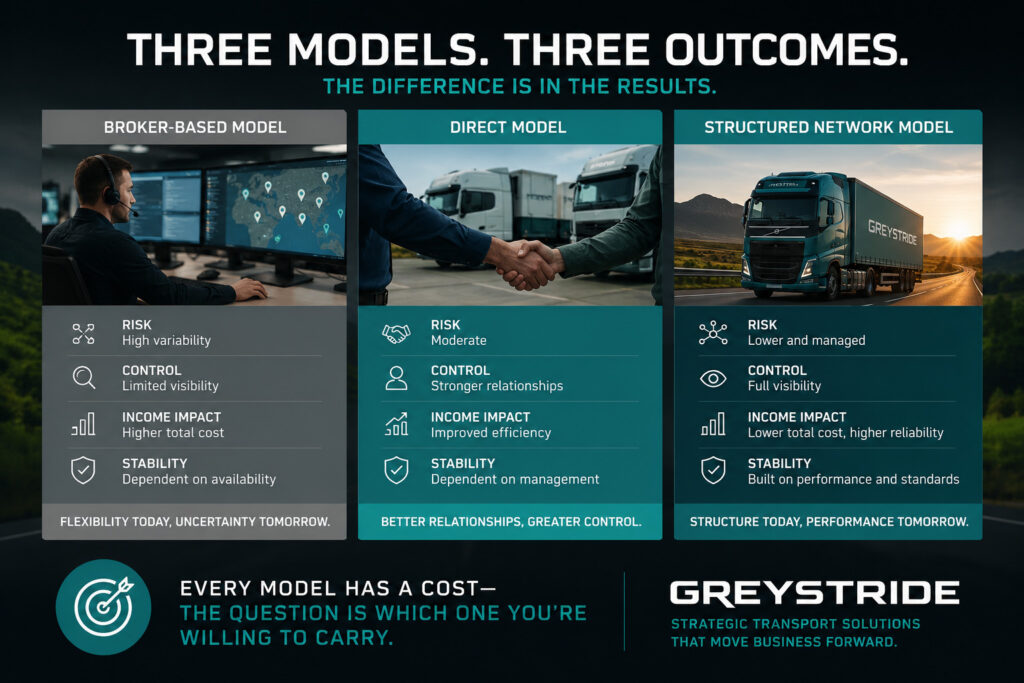
A broker-based model relies on brokers to source carriers whenever freight needs to move. This offers flexibility and broad market access, particularly during periods of high demand or when servicing unfamiliar routes. However, it also means carrier relationships often belong to the broker rather than to you. Service levels can vary between shipments, visibility is limited, and continuity depends on whoever is available at the time.
A direct carrier model establishes relationships directly with transport companies. This improves communication, accountability, and commercial transparency. Over time, carriers become familiar with your products, delivery locations, and operational requirements, creating greater consistency. The trade-off is that managing multiple carrier relationships requires internal capability, ongoing performance monitoring, and contingency planning.
A structured transport network combines many of the strengths of direct relationships while adding governance, performance standards, and coordinated oversight. Instead of managing isolated carrier relationships, you operate within a defined network where participants are selected, performance is monitored, and expectations are consistent across the entire operation.
The transport providers remain independent businesses, but they operate within a common framework designed to improve reliability and reduce operational variability.
The difference becomes clearer over time.
When comparing these models, the conversation extends well beyond transport rates.
A broker-based approach can provide immediate capacity, but consistency often depends on which carrier accepts a particular load. Knowledge of your operation may vary from shipment to shipment, making performance difficult to standardize.
Direct relationships typically provide greater control because communication flows directly between you and the carrier. Expectations become clearer, operational knowledge improves over time, and accountability is easier to establish. However, maintaining these relationships requires dedicated management and continuous oversight.
A structured network introduces another layer of stability. Performance standards are established, operational expectations are aligned, and transport providers are evaluated against consistent measures rather than individual transactions. This creates greater predictability while still allowing flexibility across multiple carriers.
The comparison is less about choosing one transport company over another and more about choosing how your transport operation is managed.
Every model carries different risks.
Broker-based operations often reduce the administrative burden of sourcing transport, but they can also reduce visibility into carrier performance and create dependence on intermediary relationships.
Direct carrier models improve transparency and strengthen long-term partnerships, yet they also place greater responsibility on your business to manage supplier performance and capacity.
Structured networks distribute that responsibility through defined governance, shared performance expectations, and coordinated management, reducing many of the risks associated with fragmented transport procurement.
Each model has strengths.
Each model also has limitations.
Understanding where those limitations begin to affect service, cost, and customer satisfaction is what separates reactive transport management from strategic transport planning.
The long-term impact reaches beyond logistics.
Transport decisions influence far more than freight movement.
They affect customer confidence, inventory planning, production schedules, procurement decisions, and ultimately the reputation of your business.
As operations grow, variability becomes increasingly expensive. Small inconsistencies across hundreds or thousands of deliveries eventually become measurable commercial risks.
Businesses that recognise this shift often stop evaluating transport purely as a procurement function and begin viewing it as an operational capability that deserves structure, measurement, and long-term consistency.
The model should support the business—not the other way around.
Every transport model has a place.
The right choice depends on your operational complexity, your appetite for risk, and the level of control your business requires as it grows.
As supply chains become more demanding, many organisations find themselves moving beyond decisions based solely on availability or price. They begin evaluating which operating model creates the greatest consistency over time.
That change is often less about replacing transport providers and more about improving the framework within which they operate.
Closing Thought
Every model has a cost—the question is which one you’re willing to carry.