
For many load providers, transport doesn’t feel broken at first.
Loads move. Trucks arrive. Rates get negotiated. Problems get solved.
Until suddenly they don’t.
A delayed collection becomes a customer issue. A rate increase appears with little warning. Capacity disappears when demand rises. Service levels shift depending on who is available this week.
And the natural conclusion is often the same:
The market is difficult right now.
There is some truth in that.
South Africa’s transport environment is under pressure. Operating costs continue to rise. Capacity moves between sectors. Economic conditions remain unpredictable. Every player in the chain feels it.
But those conditions don’t explain why the same problems seem to repeat — even when volumes change, routes change, or suppliers change.
Because in many cases, the issue isn’t only market conditions.
It’s the structure behind how transport is sourced.
A common approach is to treat transport as a transactional procurement activity: request a rate, allocate the load, move on.
On paper, it creates flexibility.
In practice, it often creates something else.
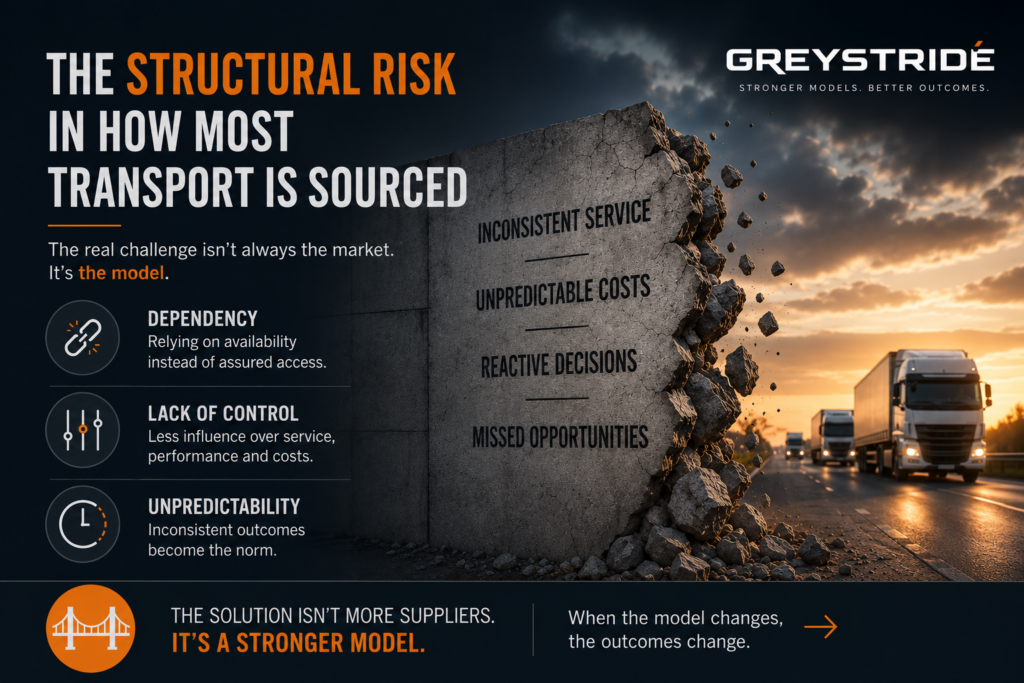
Dependency.
You become dependent on availability instead of access. Dependent on reactions instead of planning. Dependent on whoever can service the requirement today rather than building a model designed to support tomorrow.
Over time, control starts moving away from the load provider without it being obvious.
Transport becomes harder to forecast.
Performance becomes harder to influence.
Costs become harder to explain.
And unpredictability starts becoming normal.
The difficult part is that these issues rarely appear as one major failure.
They show up as small recurring friction:
late updates, inconsistent service, changing expectations, unexpected costs, and operational decisions being made under pressure.
Individually, each issue seems manageable.
Collectively, they create a system that constantly pulls attention away from growth and back into managing movement.
That is why many transport challenges feel permanent.
Not because the market never improves.
But because the model producing the outcomes stays the same.
At some point, every load provider has to ask a different question.
Not whether transport is performing badly.
But whether the way transport is being sourced is creating the very unpredictability everyone is trying to eliminate.
Because this isn’t a once-off problem—it’s built into the system.