
For many transport businesses, success still gets measured in movement.
Trucks dispatched. Loads delivered. Kilometres covered. Drivers scheduled. Problems solved.
And when pressure builds, the instinct is usually the same: work harder, move faster, push more volume.
But there comes a point where effort stops creating progress.
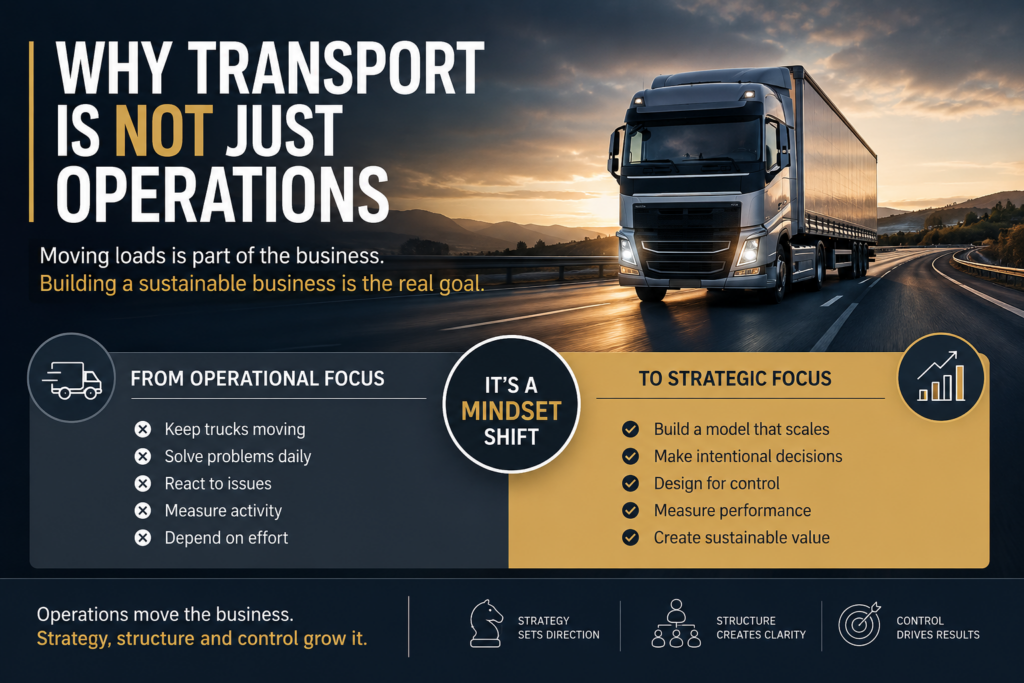
Because transport is not just operations.
That thinking made sense when the business was smaller.
When the owner knew every customer personally. When decisions happened quickly. When adding another truck felt like growth.
But scale changes the game.
More vehicles create more complexity. More customers create more variables. More people create more dependency.
And suddenly, the business that once felt manageable starts becoming difficult to control.
Margins tighten despite higher turnover.
Cash flow becomes unpredictable.
Small operational issues begin creating bigger financial consequences.
Not because operations stopped mattering.
But because operations were never meant to carry the entire business.
Strong transport businesses eventually realise something important:
Operations move the business.
Structure controls the business.
Strategy directs the business.
You can have efficient dispatching and still lose money.
You can have fully utilised trucks and still create instability.
You can deliver exceptional service and still struggle to grow sustainably.
Because transport is not only a logistics problem.
It is also a commercial model.
A capacity model.
A decision-making model.
The businesses that create resilience tend to think differently.
They stop asking:
“How do we keep trucks moving?”
And start asking:
“What system supports the outcomes we want?”
That shift changes conversations.
Customer selection becomes more deliberate.
Fleet decisions become more intentional.
Growth becomes measured against sustainability instead of activity.
Problems become easier to identify because performance is no longer judged by movement alone.
The result is not less operational focus.
It is operational focus supported by structure, visibility, and control.
And over time, those businesses often look calmer from the outside—not because they work less, but because they rely less on reacting.
Transport will always be operational.
But the businesses that endure rarely treat operations as the business itself.
At some point, every transport company has to decide whether it wants to keep managing movement—or start building a model that can support where it wants to go.
The difference isn’t effort—it’s approach.