
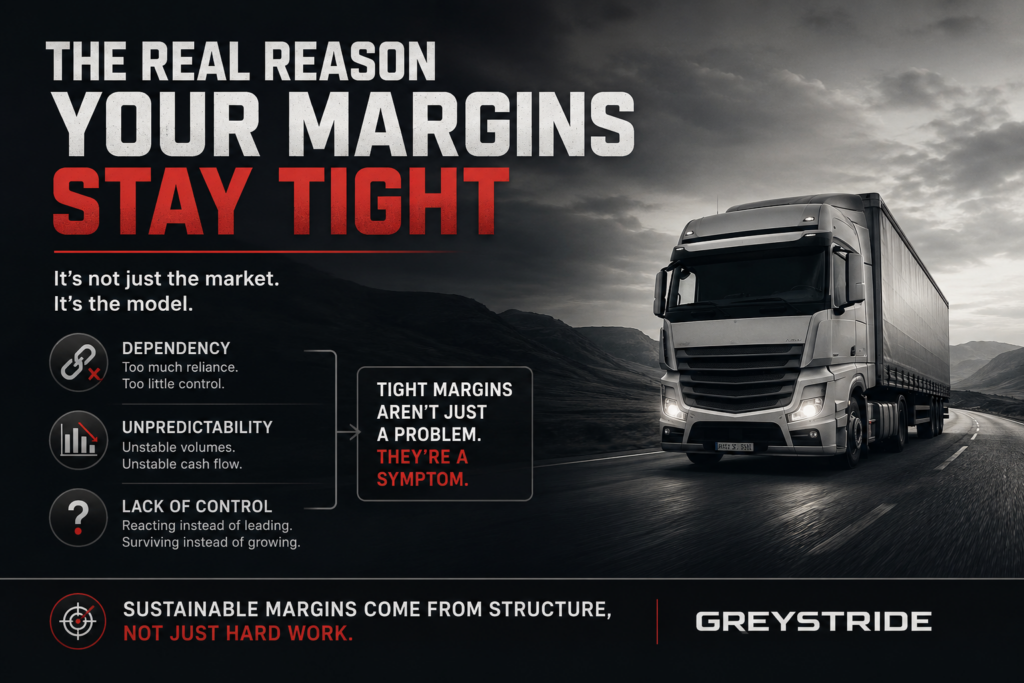
Trucks Are Moving. So Why Does It Still Feel Like a Struggle?
You’re running loads. Your fleet is busy. Drivers are working. Fuel is being burned. Tyres are wearing out. Invoices are going out.
But somehow, the pressure never really leaves.
There’s always another cash flow squeeze around the corner. Another unexpected expense. Another month where turnover looks decent on paper, but profitability feels disappointing once everything settles.
For many transport companies in South Africa, that has become normal.
And the usual explanation is easy to understand.
Rates are under pressure. Fuel keeps increasing. Maintenance costs continue climbing. Customers want more for less. The economy is difficult. Competition is aggressive.
All of that is true.
But if those were the only reasons margins stayed tight, then every operator in the same market would struggle equally.
They don’t.
Some businesses remain stuck in survival mode for years, even with good clients and decent volumes. Others operate in the exact same conditions yet manage to build stability, control, and long-term profitability.
That usually points to a deeper issue.
Because in many cases, the real problem is not only the market.
It’s the model the business depends on.
A large portion of the transport industry has quietly become trapped in systems built around dependency and unpredictability.
Dependency on a small number of clients.
Dependency on brokers.
Dependency on volumes that can disappear with little warning.
Dependency on rates that are constantly negotiated downward.
The result is a business that works hard but operates with very little control.
And when control disappears, margins become fragile.
One delayed payment creates pressure.
One quiet month affects cash flow.
One major repair disrupts operations.
One lost contract forces desperate decisions.
Over time, the business becomes reactive instead of strategic.
That’s why the same problems keep repeating.
Not because operators are inexperienced.
Not because people aren’t working hard enough.
But because the structure itself creates instability.
Many transport companies are trying to build sustainable businesses on top of unpredictable foundations.
And unpredictability is expensive.
It affects planning.
It affects pricing.
It affects maintenance decisions.
It affects driver management.
It affects fleet expansion.
Eventually, it affects confidence.
You start focusing more on keeping trucks moving than building a business that can actually absorb pressure.
That’s where many margins quietly disappear — not in one major event, but through constant operational instability that slowly erodes profitability over time.
The difficult part is that these issues often don’t look like structural problems at first.
They look like temporary setbacks.
A slow-paying customer.
A weak quarter.
A fuel increase.
A rate issue.
But when the same pressures continue year after year, it usually means the business is operating inside a system that naturally produces those outcomes.
And that changes the conversation completely.
Because if the model itself creates instability, then working harder inside the same structure rarely solves the problem for long.
At some point, every transport business has to ask an uncomfortable question:
Is the operation built for long-term control — or just long-term survival?
This isn’t a once-off problem — it’s built into the system.