
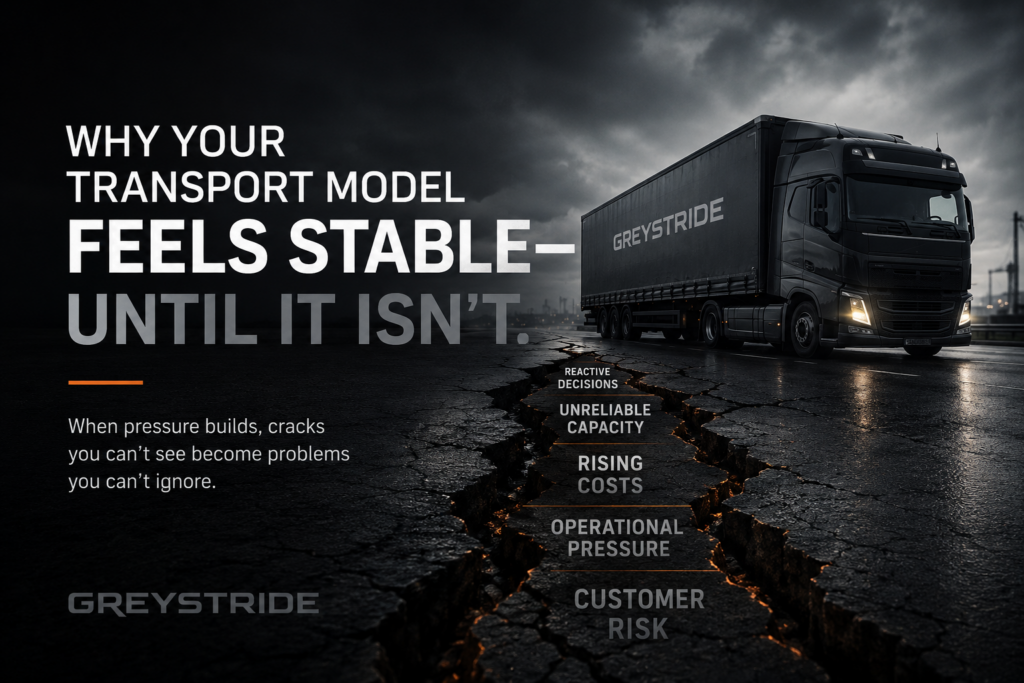
There’s a point where “everything is moving” starts getting mistaken for “everything is working.”
Loads are being collected. Deliveries are being made. Phones are ringing. Reports are being sent. The transport operation looks active from the outside, and on most days, it feels stable enough to keep going.
Until one disruption exposes how fragile the entire model actually is.
A delayed vehicle suddenly affects customer commitments. One transporter underperforms and the pressure spreads across multiple deliveries. Rates increase without warning. Communication breaks down at the worst possible time. Capacity disappears during peak demand. What looked manageable last month suddenly becomes reactive overnight.
And in many businesses, this doesn’t happen because people are careless.
It happens because the operation became dependent on momentum instead of structure.
The reality is that many load providers are carrying more transport pressure than they realise. Internally, there’s constant coordination. Constant follow-ups. Constant firefighting to keep deliveries moving and customers satisfied. Teams become consumed with managing exceptions instead of improving performance.
Over time, the business adapts to the pressure so completely that the pressure starts feeling normal.
That’s where the danger sits.
In the South African transport environment, instability rarely arrives with a warning sign. It builds quietly through small inefficiencies, inconsistent service levels, fragmented communication, rising operational complexity, and transport relationships that were never designed to scale properly.
The challenge is that activity can easily create the illusion of control.
A busy operation can still be an inefficient one.
And a transport model that “works” today may only be surviving because experienced people are compensating for weak systems behind the scenes.
That distinction matters more than most businesses think.
Because eventually the cost of carrying operational strain starts showing up elsewhere. Customer experience becomes inconsistent. Internal teams become frustrated.
Growth becomes harder to manage. Decisions become reactive instead of strategic. More effort goes in, but very little actually improves.
At that point, the issue is no longer transport alone.
It becomes a business structure problem.
The companies that remain stable long term are usually not the ones moving the most loads. They are the ones that created transport models capable of handling pressure without depending on constant intervention to survive.
That requires a different way of thinking.
Not just asking whether loads are moving.
But asking what it is really costing the business to keep them moving.
Because sometimes the biggest operational risks are hidden inside systems that still appear to be functioning.
And eventually, every business reaches the point where “manageable” is no longer good enough.