
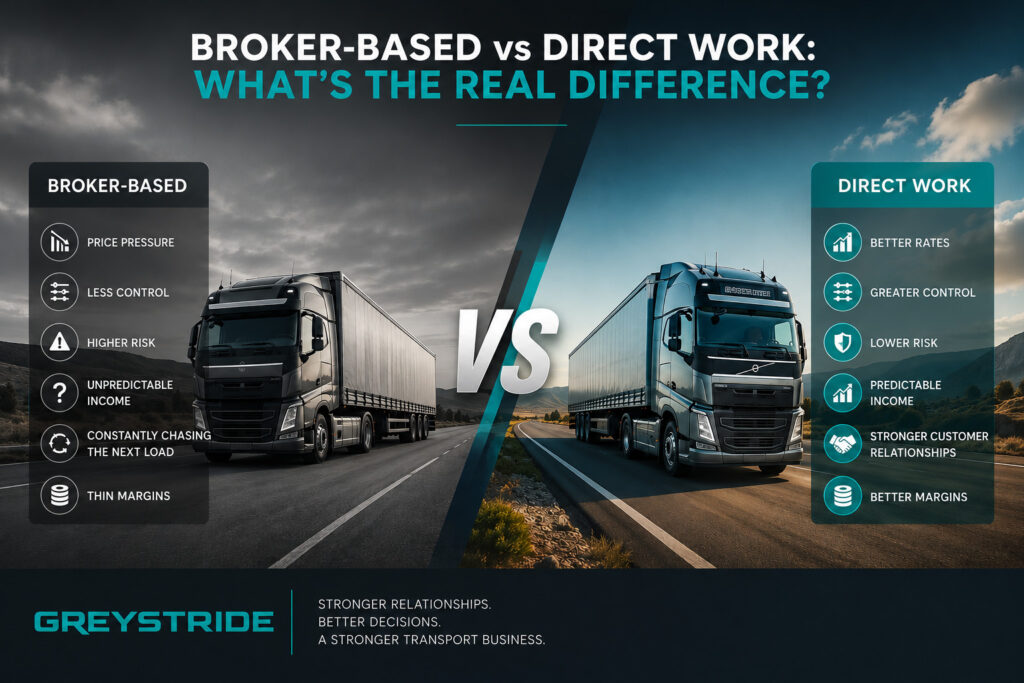
The work may look the same—but the business behind it often isn't.
Two transport companies can run similar trucks, travel the same routes, and deliver freight to the same destinations. Yet one constantly fights for work, negotiates on price, and worries about the next load, while the other enjoys stronger customer relationships, greater predictability, and more control over its future.
The difference is often not operational. It’s the business model.
Two Models. Two Different Businesses.
For many transport companies in South Africa, brokers play an important role in keeping trucks moving. They provide access to loads, help fill capacity, and can be invaluable during quieter periods or when entering new markets.
The challenge arises when brokered work becomes the foundation of the business rather than one part of it.
A business built primarily on brokered freight often relies on opportunities that are controlled by someone else. Load availability, pricing, customer relationships, and future work are largely influenced by external decisions.
A business with direct customer relationships operates differently. While it still faces the same operational challenges, it has greater influence over pricing discussions, service expectations, contract terms, and long-term planning.
The trucks may be doing the same work. The business is not.
Looking Beyond Today's Load
When comparing broker-based work with direct customer relationships, the differences become clearer over time.
Risk
Broker-based work can expose your business to changing demand, fluctuating rates, and increasing competition for available loads. When market conditions change, your revenue often changes with them.
Direct customer relationships don’t eliminate risk, but they reduce dependence on external decisions. Long-term agreements and established partnerships can create greater resilience during difficult market conditions.
Control
With brokered work, many commercial decisions happen before the load reaches you. Pricing, customer expectations, and contract conditions have often already been determined.
Direct work gives you a seat at the table. Conversations happen with the customer, allowing greater influence over service levels, scheduling, pricing, and future opportunities.
Income
Brokered freight can generate consistent activity, but higher truck utilisation does not always translate into stronger profitability. Every additional layer between you and the customer affects the economics of the load.
Direct relationships remove some of those layers, allowing more of the transport value to remain within your business.
Stability
Broker-based businesses often spend significant time replacing completed work with new work.
Businesses built on direct relationships tend to focus more on strengthening existing partnerships while selectively adding new customers, creating a more stable platform for growth.
Neither Model Is Perfect
This is not a question of one model being universally right and the other universally wrong.
Brokered work provides flexibility, opens doors to new opportunities, and helps many transport companies keep their fleets productive. For newer operators and businesses managing changing demand, it can play an important strategic role.
Direct customer relationships require time, credibility, consistent service, and the ability to build trust. They are not created overnight, and they come with their own responsibilities.
The important question is whether your current mix supports the business you want to build over the next five or ten years.
Your Business Model Shapes More Than Revenue
The model you choose influences far more than monthly turnover.
It affects how predictable your cash flow becomes, how confidently you invest in your fleet, how easily you attract skilled drivers, and how much certainty you have when making long-term business decisions.
Over time, the structure behind your revenue becomes just as important as the revenue itself.
A transport company that owns its customer relationships often has greater flexibility to plan ahead, invest strategically, and navigate changing market conditions with confidence.
Looking Beyond the Next Load
Many successful transport businesses don’t abandon brokered work entirely. Instead, they gradually build a stronger balance by increasing the proportion of direct customer relationships over time.
That shift isn’t simply about reducing reliance on brokers. It’s about increasing control over the future of the business.
As the market becomes more competitive, the companies that thrive are often those that have invested not only in reliable trucks and efficient operations, but also in stronger commercial foundations.
Closing Thought
Every model has a cost—the question is which one you’re willing to carry.