
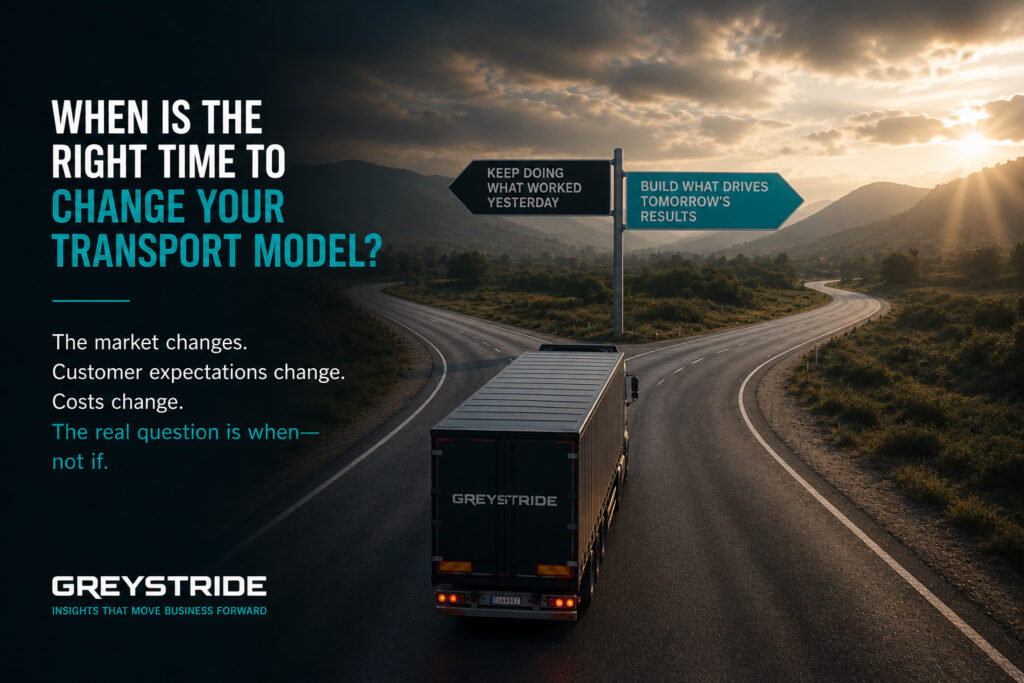
Are you still running the transport business that got you here—or the one that will take you where you want to go?
Every transport business reaches a point where working harder no longer delivers better results.
The trucks are moving. Customers are being serviced. The business is operating much as it always has. From the outside, nothing appears to be wrong.
But underneath the daily activity, something has changed.
Margins are becoming tighter. Finding quality loads is taking more effort. Customer expectations continue to rise, while operating costs remain unpredictable. The pressure isn’t coming from a single problem—it is coming from the way the market has evolved.
The challenge is that many businesses respond by working within the same operating model that was successful years ago. They pursue more loads, accept lower margins, add more administration, or rely on the same relationships that have always kept the trucks moving.
Those decisions may keep the business running, but they rarely position it for long-term growth.
A transport model should not only support today’s operations. It should give your business the ability to adapt when the market changes.
That is often the first sign that change is needed.
Changing your transport model does not necessarily mean replacing your fleet, entering new markets, or making dramatic operational changes. More often, it means reconsidering how work is secured, how customers are developed, how decisions are made, and whether your current structure still creates the outcomes you expect.
Many transport companies delay that conversation because the business is still functioning.
But functioning is not the same as progressing.
Waiting until profitability is under pressure, key customers are lost, or cash flow becomes difficult usually limits the number of options available. By then, change becomes reactive rather than strategic.
The strongest businesses tend to make important decisions before circumstances force them to. They recognise that today’s operating model may not be the right model for the next stage of growth.
That requires looking beyond day-to-day operations and asking whether the business is still structured to compete in the market that exists today—not the one that existed five or ten years ago.
Every transport company eventually reaches a point where maintaining the current model becomes a decision in itself.
The real question is when—not if.