
Most transport operations don’t change overnight.
There isn’t a dramatic announcement, a new fleet, or a sudden breakthrough. More often, the difference begins with a simple decision to move away from reacting to daily problems and towards managing transport through a clear, structured approach.
The impact becomes visible much sooner than many businesses expect.
For many South African load providers, transport has evolved over time rather than by design. Different carriers are added as volumes increase. Brokers are introduced to fill urgent gaps. Relationships develop independently across procurement, operations, and logistics teams. Individually, these decisions make sense. Collectively, they create unnecessary complexity.
The result is familiar.
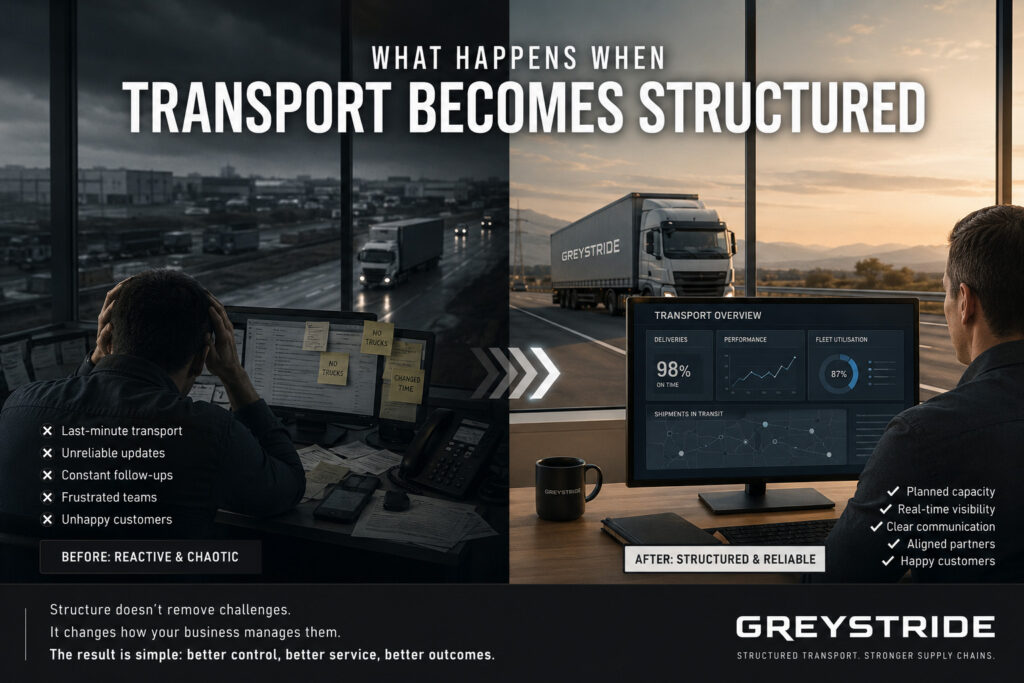
One week everything runs smoothly. The next week a trusted transporter has no available vehicles. A replacement carrier is sourced at short notice. Collection times change. Delivery expectations shift. Communication becomes fragmented, and internal teams spend valuable time following up on information that should already be available.
The freight still moves.
But it requires constant attention to keep everything on track.
Now consider the same operation after transport becomes structured.
Instead of managing a growing list of transport providers, you work with a carefully selected group of carriers that understand your business, your delivery requirements, and your operating standards.
Capacity planning becomes more predictable because your transport partners understand upcoming demand patterns.
Communication becomes simpler because everyone follows the same process.
Performance is measured consistently instead of relying on assumptions or isolated incidents.
When an unexpected disruption occurs—and in transport it inevitably will—the response is coordinated rather than improvised. Alternative capacity is already understood, responsibilities are clear, and decisions can be made quickly without creating confusion across the supply chain.
The daily experience changes.
Operations teams spend less time chasing updates.
Procurement teams spend less time sourcing emergency capacity.
Customers receive more consistent service because delivery commitments are based on reliable execution rather than optimism.
None of this requires perfect conditions.
South African transport will always face road closures, weather disruptions, vehicle breakdowns, labour challenges, and changing customer demand. Structure does not eliminate these realities.
It changes how your business responds to them.
Instead of every disruption becoming a new crisis, your transport operation develops the resilience to absorb normal industry variability without creating unnecessary operational pressure.
That shift often produces benefits that extend well beyond transport itself.
Inventory planning becomes more reliable because delivery performance is more consistent.
Production schedules experience fewer interruptions.
Customer service teams spend less time managing complaints.
Management gains clearer visibility into transport performance, making strategic decisions easier and more informed.
The change isn’t driven by working harder.
It’s driven by creating a transport model where people, processes, and carrier relationships operate within a consistent framework rather than relying on daily intervention.
Over time, that consistency becomes a competitive advantage.
Not because transport becomes flawless, but because it becomes predictable.
In an environment where uncertainty is part of doing business, predictability is often one of the most valuable outcomes a supply chain can achieve.
The change wasn’t massive—but the impact was.