
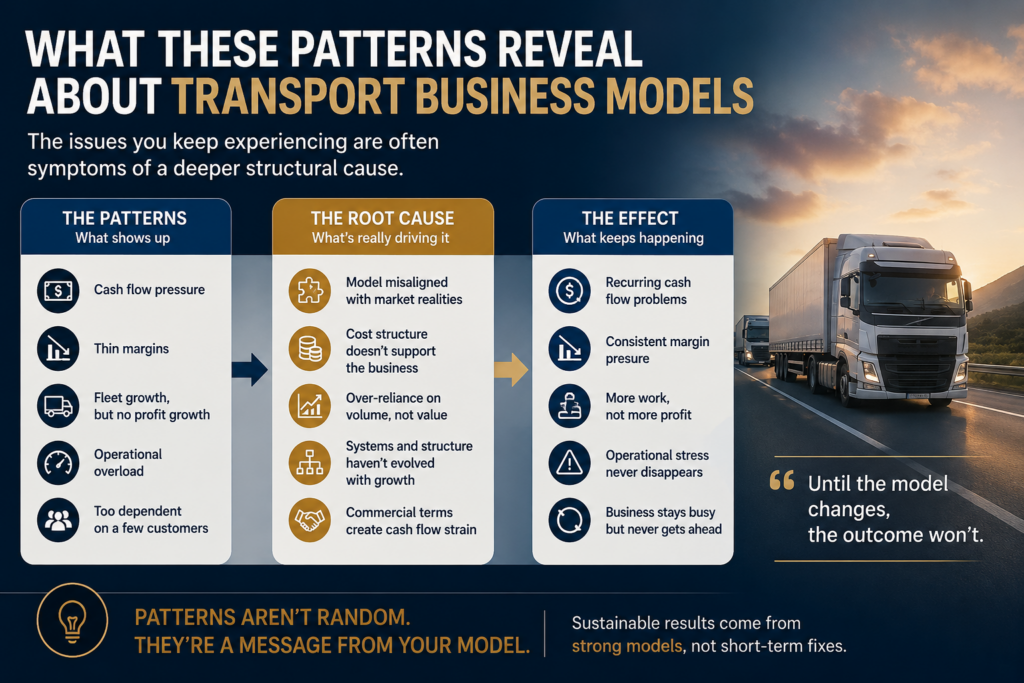
Most transport operators can spot the patterns.
Revenue grows, but cash remains tight.
The fleet gets bigger, but profitability doesn’t improve.
More work comes in, yet operational pressure increases instead of decreasing.
These situations often appear unrelated. They show up at different times, in different parts of the business, and are usually treated as separate problems.
But over time, a different picture starts to emerge.
The same challenges keep returning.
The same pressure points keep appearing.
And the same conversations keep happening.
At some point, it becomes clear that the pattern is not the problem.
The pattern is the clue.
Looking Beyond the Symptoms
In many South African transport businesses, management spends significant time dealing with visible issues.
Late payments.
Rising fuel costs.
Driver shortages.
Unexpected maintenance expenses.
Low margins.
Customer demands.
These challenges are real, and they require attention.
The difficulty is that businesses often become trapped in a cycle of responding to symptoms while the underlying cause remains untouched.
As a result, the pressure never truly disappears.
It simply changes shape.
One month it shows up as a cash flow problem.
The next month it appears as a capacity problem.
Then it becomes a profitability problem.
The symptom changes, but the source remains the same.
The Business Model Behind the Pattern
Every transport business operates according to a model.
That model determines how work is won, how vehicles are utilised, how costs are structured, how customers are serviced, and ultimately how profit is generated.
When that model is aligned with market realities, the business tends to absorb challenges more effectively.
When it is misaligned, recurring pressure begins to build.
For example, a business may pursue growth through volume while operating on margins that are too thin to support expansion.
Another may depend heavily on a small number of customers whose payment terms create constant cash flow strain.
Some operators continue adding vehicles because demand exists, while the management systems needed to support a larger fleet never evolve at the same pace.
From the outside, these situations look like operational problems.
In reality, they are often structural problems.
The Cause-and-Effect Connection
Business outcomes are rarely random.
A transport company that constantly experiences cash flow pressure usually has a structural reason behind it.
A fleet that grows without improving profitability often reflects a commercial or operational model that is failing to convert activity into profit.
A business that remains dependent on the owner for every important decision may have outgrown the structure that once worked when the fleet was smaller.
The relationship is simple:
The business model creates the conditions.
Those conditions create the outcomes.
The outcomes eventually become visible as recurring patterns.
Until the cause is addressed, the effect continues.
Why Time Doesn't Fix It
One of the biggest misconceptions in business is the belief that experience alone will solve structural problems.
Many operators assume that another customer, another vehicle, or another busy season will eventually relieve the pressure.
Sometimes it does temporarily.
Most of the time, it doesn’t.
Growth placed on top of an unstable structure often magnifies the weaknesses that already exist.
The larger the business becomes, the more expensive those weaknesses become.
What feels like a temporary challenge can gradually become a permanent feature of the business.
Years pass.
The same issues remain.
Only the numbers get bigger.
When the Pattern Becomes the Message
Recurring patterns deserve attention because they reveal something deeper than day-to-day operational challenges.
They provide insight into how the business is actually functioning beneath the surface.
When the same pressure points continue appearing despite repeated efforts to solve them, the conversation often needs to move beyond operations and into structure.
Not because the business is failing.
But because the model that created previous success may no longer be capable of supporting the next stage of growth.
That is often where meaningful change begins.
Not with another short-term fix.
But with a willingness to question whether the current structure is producing the outcomes the business truly wants.
Because until the model changes, the outcome won’t.