
Most transport companies start the same way.
A truck. A customer. A commitment to deliver.
Then another truck gets added. Another customer comes on board. More drivers are hired. More loads need attention.
Before long, the business is moving a significant amount of freight every month.
From the outside, it looks successful.
But underneath, many operators are still carrying the business in much the same way they did when they started.
The difference is that the stakes are now much higher.
The Businesses That Operate Differently
Across the transport industry, some businesses seem to navigate challenges more effectively than others.
They are not necessarily the biggest fleets.
They do not always have the newest equipment.
And they are not immune to the pressures facing the industry.
Fuel prices still increase.
Customers still negotiate rates.
Breakdowns still happen.
Yet these businesses often appear more stable, more predictable, and better positioned for growth.
The reason is usually not luck.
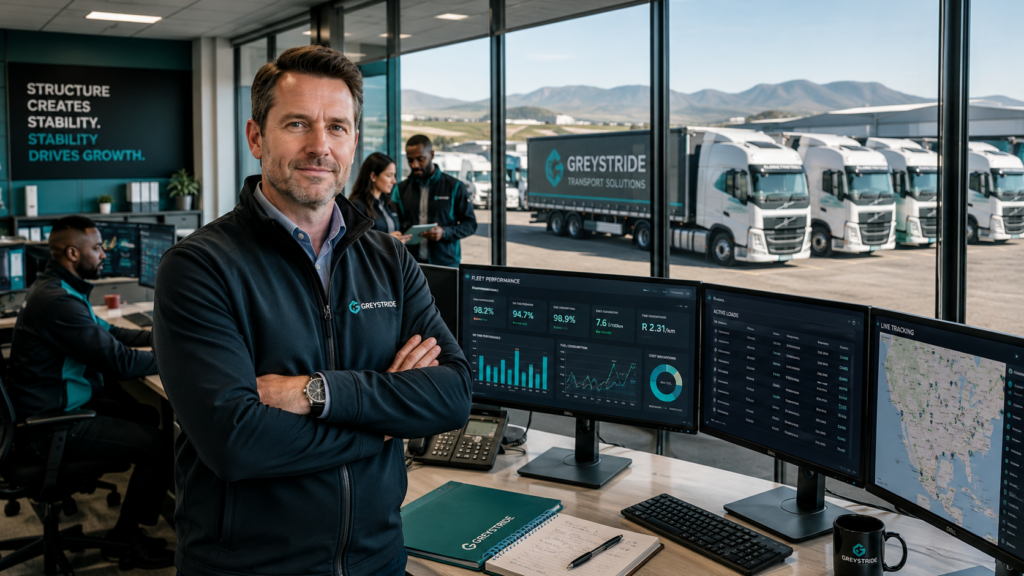
It is structure.
Structure Creates Stability
A structured transport business does not rely on memory, urgency, or a handful of individuals holding everything together.
Information is accessible.
Responsibilities are clear.
Processes are understood.
Decisions are based on facts rather than assumptions.
Cash flow is monitored consistently.
Customers receive a consistent experience.
Suppliers know what to expect.
Drivers understand their responsibilities.
Management can see problems developing before they become crises.
When structure exists, the business becomes less dependent on reacting and more capable of planning.
That shift changes everything.
The Hidden Advantage
Many operators view structure as an internal matter.
Something that improves efficiency or reduces mistakes.
While that is true, the impact reaches much further.
Well-structured businesses often find it easier to build stronger relationships throughout the industry.
Customers gain confidence when they see consistency.
Suppliers are more comfortable extending support when they trust the business behind the account.
Potential partners are more willing to engage when they can see professionalism and stability.
Opportunities tend to flow toward businesses that appear capable of handling them.
Not because they are perfect.
Because they are prepared.
Stability Opens Doors
One of the biggest misconceptions in transport is that growth creates stability.
In reality, stability often creates growth.
Businesses with structure generally have greater visibility over their operations.
They understand their numbers.
They can identify risks earlier.
They make decisions with greater confidence.
That predictability improves positioning.
It improves credibility.
And it often improves access to opportunities that may never become available to businesses operating in constant firefighting mode.
Over time, the gap becomes noticeable.
Not because one business works harder than another.
But because one business is operating from a stronger foundation.
Looking Beyond the Trucks
When people assess a transport company, they often focus on fleet size.
How many trucks.
How many trailers.
How many loads are moving.
But some of the strongest businesses in the industry are defined by something less visible.
They have structure behind the operation.
They have systems supporting decisions.
They have relationships built on consistency.
They have access to opportunities because others trust their ability to execute.
That foundation is difficult to see from the outside.
Yet it is often the reason some businesses continue to move forward while others remain stuck despite working just as hard.
Some businesses operate differently—and it shows.