
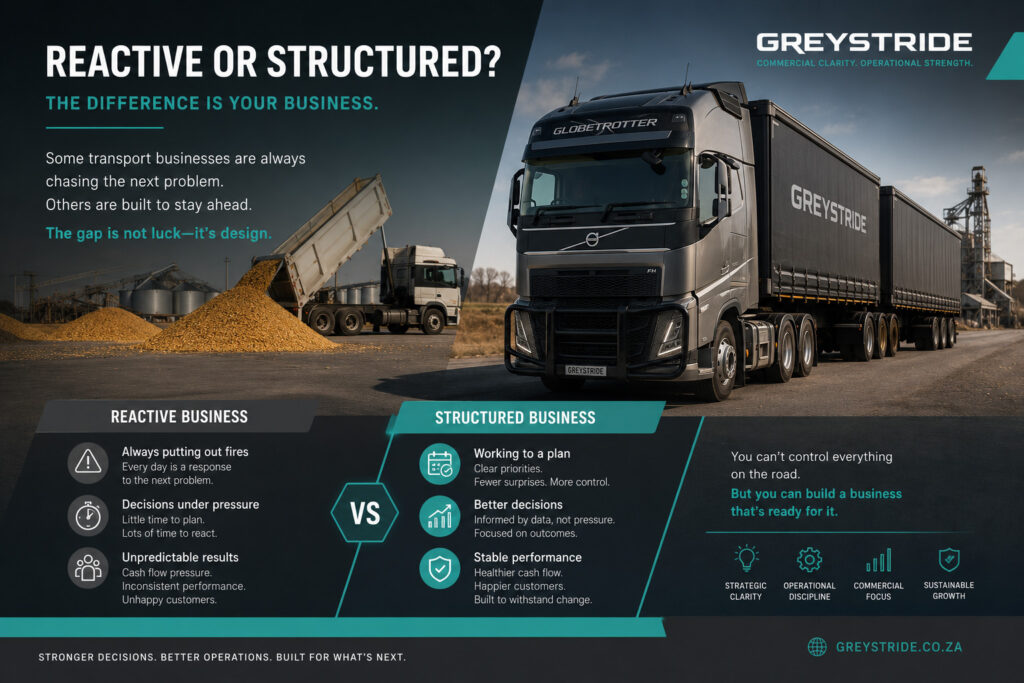
Some Transport Businesses Always Seem to Be Fighting Fires. Others Rarely Do.
Spend enough time in the South African transport industry and a pattern becomes obvious.
Some operators are constantly dealing with late payments, vehicle breakdowns, customer complaints, scheduling conflicts and cash flow pressure. Every week brings a new crisis that demands immediate attention.
Others face many of the same external challenges—rising fuel costs, demanding customers, changing regulations and difficult operating conditions—but their businesses remain steady, predictable and in control.
The difference is rarely the market they serve.
More often, it’s how the business is built.
The Same Industry. Very Different Outcomes.
Reactive transport businesses spend most of their time responding to whatever happens next.
When a truck breaks down, the focus shifts to finding repairs. When cash flow tightens, attention turns to collecting outstanding invoices. When a customer complains, resources are redirected to fixing the immediate problem.
None of these responses are wrong. They are often necessary.
The challenge is that the business never gets ahead of its problems because every decision is driven by today’s urgency rather than tomorrow’s priorities.
Structured transport businesses operate differently.
They still experience breakdowns. Customers still make unexpected requests. Economic conditions still change.
The difference is that they have systems, processes and commercial discipline that reduce the number of surprises they face. Instead of constantly reacting, they spend more time anticipating.
That changes everything.
Structure Changes the Way Decisions Are Made
Reactive businesses often rely on experience, memory and individual effort.
Important information lives with specific people. Processes differ depending on who is available. Decisions are made quickly because there is little time to step back and evaluate alternatives.
This approach can work for a while, especially in smaller operations.
But as the business grows, complexity grows with it.
More vehicles, more drivers, more customers and more suppliers create more opportunities for small issues to become expensive problems.
Structured businesses recognise this early.
They create consistent ways of planning work, monitoring performance, managing costs and reviewing commercial decisions. They don’t depend on one person remembering everything because the business itself provides the framework for making good decisions.
That consistency creates stability.
Better Performance Is Usually Designed, Not Discovered
From the outside, structured businesses can appear fortunate.
Their vehicles spend more time on the road. Customers stay longer. Cash flow seems healthier. Operations run more smoothly.
It can look like they simply have better clients or more favourable circumstances.
In reality, many of those outcomes are the result of deliberate design.
Clear operating processes reduce costly mistakes.
Better financial visibility allows problems to be identified before they become crises.
Defined commercial standards lead to stronger customer relationships and better decision-making.
The business becomes more predictable because uncertainty has been reduced wherever possible.
That’s not luck.
It’s structure.
Why This Matters
South Africa’s transport industry will always involve uncertainty.
Fuel prices move. Road conditions change. Equipment fails. Markets shift.
No business can eliminate these realities.
But every business can decide how prepared it wants to be when they arrive.
The more reactive a business becomes, the more its future is shaped by external events.
The more structured it becomes, the more control it gains over its own performance.
That difference affects profitability, customer confidence, operational consistency and long-term growth.
Structure Is More Than Administration
Many people associate structure with paperwork, policies or additional administration.
In reality, good structure creates clarity.
It helps people understand how decisions are made, what standards are expected and where the business is heading.
Instead of slowing the business down, it often allows it to move faster because fewer decisions are made under pressure.
Strong transport businesses are rarely built on constant urgency.
They are built on repeatable systems that allow good decisions to happen consistently.
The Gap Is Not Luck—It's Design.
Every transport business faces challenges.
The businesses that continue to grow are not necessarily the ones with the easiest operating environment.
More often, they are the ones that have built a business capable of handling complexity without becoming overwhelmed.
The real question is whether your current business model is helping you stay ahead of challenges—or simply keeping up with them.
Because the gap between reactive and structured transport businesses is not luck—it’s design.